

Cobalt Yellow, Aureolin
PY40
Alternate Name
Aureoline
Pigment Description
Cobalt yellow is a golden yellow full of surprises, also known as Aureolin or Aureoline. It's a bit cooler than caramel in masstone, but has surprising behavior in glazes. While cobalt is often associated with blue or violet, this is a yellow made from Potassium Cobaltinitrite. This color was prized for being a transparent to semi-transparent yellow. Sadly, the lightfastness of this historical pigment was not as great as was hoped. Usually ASTM II is cited for Aureolin, but in Golden's Recent Lightfastness tests it was one of several pigments that struggled in Safflower oil, WB Flake White, and Lithopone. It is one of the yellows that is sensitive to moisture and didn't respond as well to humidity either. Cobalt Yellow was discontinued, as discussed more here.
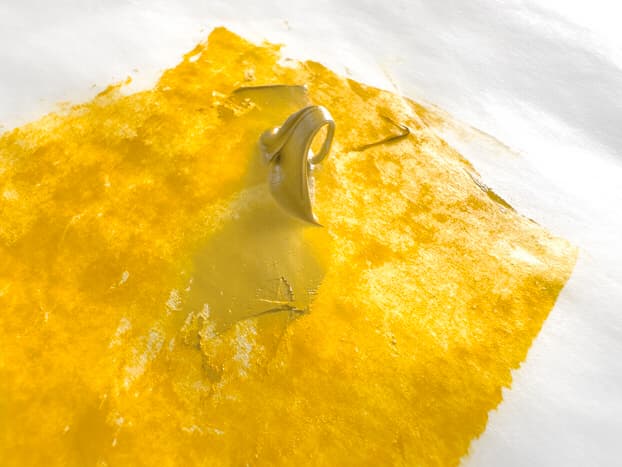
Vintage Cobalt Yellow, PY40 by Winsor and Newton
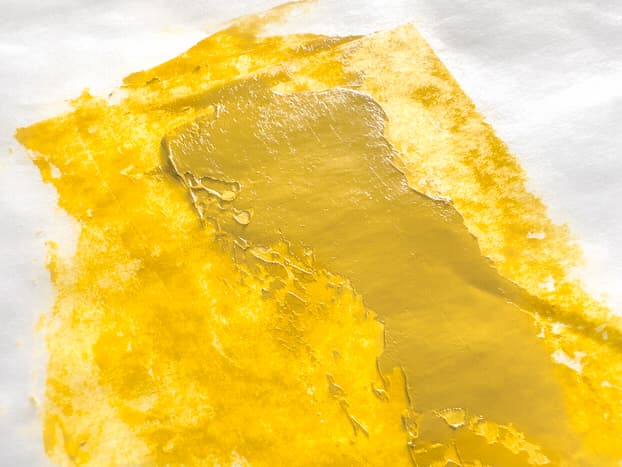
Cobalt Yellow is markedly different in masstone than when spread thinly. When thinned, our vintage version was is a chromatic yellow, when slightly thicker there is a hint of a warmer orangy-caramel, and when thick it is an almost greener caramel.
Monona Rossol's work mentions some health problems that can arise from it, see her research here. The Artist's Guide to Health and Safety has information about the hazards of pigments containing cobalt. This color may also cause methemoglobinemia.
Resources
PY40 pigment data from David G. Myers, The Color of Art Pigment Database, Artiscreation.com
Information about PY40 from Bruce MacEvoy, Handprint Guide to Watercolors, General information about this class of pigments from Handprint,
Rossol, Monona. The Artist's Complete Health and Safety Guide. New York, NY : Allworth Press, 2001. The book is rather dated, updated information is available from her website.
Stats
Lightfastness
Good or decent, but may be less lightfast than was once thought. Depends on Variables. Fairly reactive with different mixing whites.
This color is surprisingly variable depending on the choice of whites in oil. In Golden’s recent testing it tanked in Flake White (Linseed and Safflower), Lithopone (Safflower), pure Zinc White, and pure Titanium in Safflower. Oddly, it performed on the other end of the scale at ASTM I with pure Titanium White in Linseed oil as well as Titanium-Zinc. More details can be found here. Bruce MacEvoy’s tests rate it in watercolor as ASTM III (fair) - what we would consider to be poor lightfastness.
Transparency
Transparent
We have seen oil paints listed as anything from Opaque to Transparent, though it is Transparent in watercolor.
Toxicity
Toxic
Artiscreation gives this a mixed rating between B and C for severity, so we’ll go with C, "Hazardous, use appropriate precautions for handling toxic substances, especially if working with the dry powder; Do not ingest; Avoid dust & spray." Additionally, Monona Rossol’s work contains cautions cobalt pigments. Information may be requested here and general remarks can be found in the Artist's Guide to Health and Safety. This color may also cause methemoglobinemia.
Dry Time
Fast
Many cobalt-containting paints are quick driers, and many of the oil paints we’ve seen dry in 1-2 days.
Oil Content
Varies, Low to Very High
The overall consensus was low by volume. Many brands don't publish oil content by volume, but Williamsburg has categorized their paints by oil volume. This color was listed as the lowest oil content by volume in their line. However, Mayer lists the oil volume to be very high, and he assigns it a 174.
Particle Size
Fine
Chemical Name
Potassium cobaltnirite
DISCLAIMER: Please note that we are not experts in health and safety and we are not toxicologists, please consult the proper experts. We are not liable for any issues that may arise from the use of our website or its contents. The information contained in this site is provided without warranty or guarantee of any kind. We do not necessarily endorse any other website that are linked from our site. For any important pigment specs, please reference the manufacturer details. If you discover errors or omissions, please reach out through our contact form. Thank you.
